The brief
Since 2026, Juan has been building the creative operating system for Meta advertising at a US performance-marketing company — an ongoing engagement. The mandate: make high-velocity ad production a system — structured experimentation, brand-consistent output, and a feedback loop from performance data back into creative — instead of a pile of one-off assets.
This page is different from the other three cases on purpose: it documents systems, not results. The engagement is live and its performance data belongs to the client — so none is shown, and none is invented.
Why creative velocity is the bottleneck
On today's Meta, the creative is the targeting: broad audiences plus the algorithm mean your ad, not your audience settings, decides who you reach. Creative also fatigues fast — which makes production speed a ranking factor in all but name. Most teams answer with heroics: one-off briefs, one-off prompts, one-off assets. Heroics don't compound. Systems do.
The pipeline
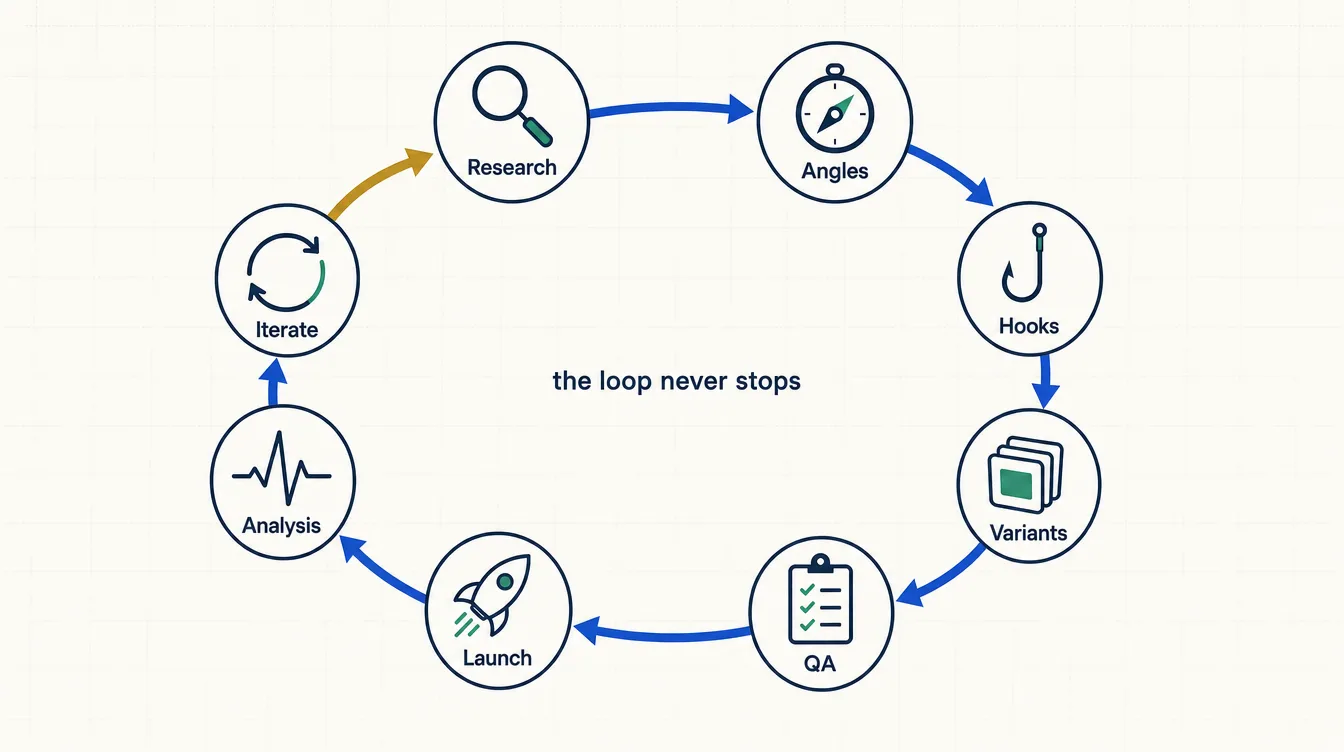
Every piece of creative moves through the same eight stages — research, angle strategy, hook generation, copy/image/video variants, QA, launch, performance analysis, iteration — and what analysis learns flows straight back into the next round's research. One closed loop, run continuously:
Brand memory: captured once, reused everywhere
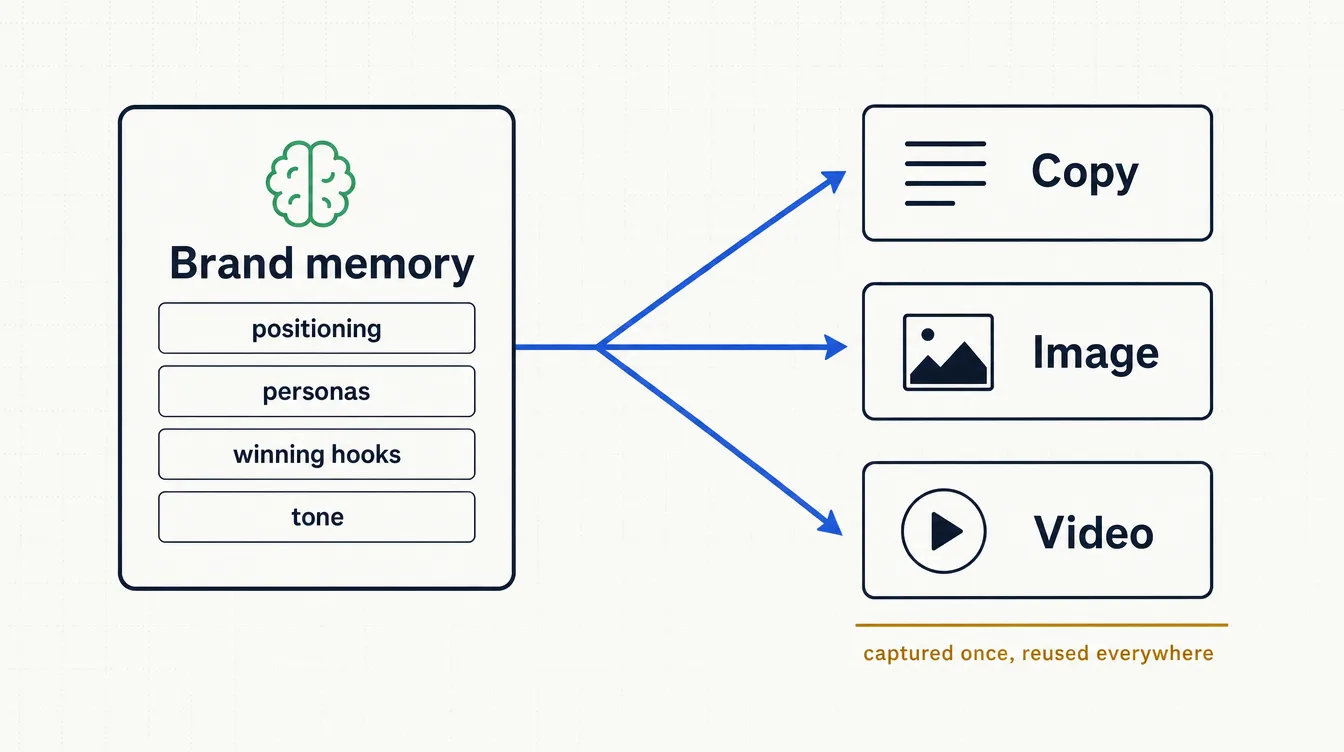
The heart of the system is a reusable brand and offer memory: product positioning, audience personas, winning hooks, visual style rules, tone of voice and funnel structure — captured once, versioned, and fed into every generation. On top of it sits a prompt architecture for ad concepts, headlines, UGC scripts, landing-page sections, visual prompts, video storyboards, creator personas and testing matrices.
Synthetic media, tested in production
The image and video layer runs on synthetic media workflows — creator-style ads, realistic product and demo scenes, native ad thumbnails, avatar variations, short-form video concepts — built by evaluating 10+ AI models in production (OpenAI, Claude, Midjourney, Runway, Kling, Veo, Higgsfield and the rest of the fast-moving field) against one question: does it ship usable ads, repeatably?
From craft to system
The last mile is what makes it an operating system rather than one person's talent: SOPs, tagging structures, variation logic and launch-ready templates, so media buyers and creatives generate consistent, measurable output without bespoke production. Performance data connects back to creative intelligence — repeatable patterns by hook, format, audience, offer, emotion, visual style and funnel stage.
The honest reading
This is a systems case — the numbers live elsewhere. The engagement is ongoing and its results are the client's to share, not ours. If you want performance receipts, the other three cases carry them, dashboards included. What this case documents is the machinery — because "we use AI" is a slogan, and a pipeline is a fact.
What this proves for your business
Station 3 of the Irgella Engine promises scroll-stopping creatives produced with AI. This is what that means in practice: the same pipeline — research-fed angles, brand memory, synthetic media, written testing rules — scaled down to a small-business budget. You don't pay for a creative team of four; you pay for the system that replaces one.
Company withheld; engagement ongoing (2026–present). No client performance data is disclosed on this page. Pipeline, tooling and workflow descriptions match the work as practiced.
Prefer Spanish? The teaching teardown of this case lives in the founder's free library: magoallegri.com — caso-sistemas-creativos-ia.